Measurements
Measurements Matter: Can You Really Get Ultra-low Frequencies Down to 5 and 10 Hz from a Tiny Enclosure?
If you’ve ever compared subwoofer spec sheets, you’ve probably noticed something strange: Some brands claim earth-shaking bass down to super low frequencies from a tiny box, while ASCENDO’s published numbers look more modest.
That’s not because our subwoofers don’t go deep (we are the leaders in infrasonic bass, after all). It’s because we refuse to publish fantasy specs.
We publish data that reflects what you’ll actually hear, not marketing graphs that fall apart the moment you turn the volume up. Claims of infrasonic bass from small-enclosure subwoofers should make you raise an eyebrow.
Why Our Frequency Specs Look Conservative — And Why That’s Good
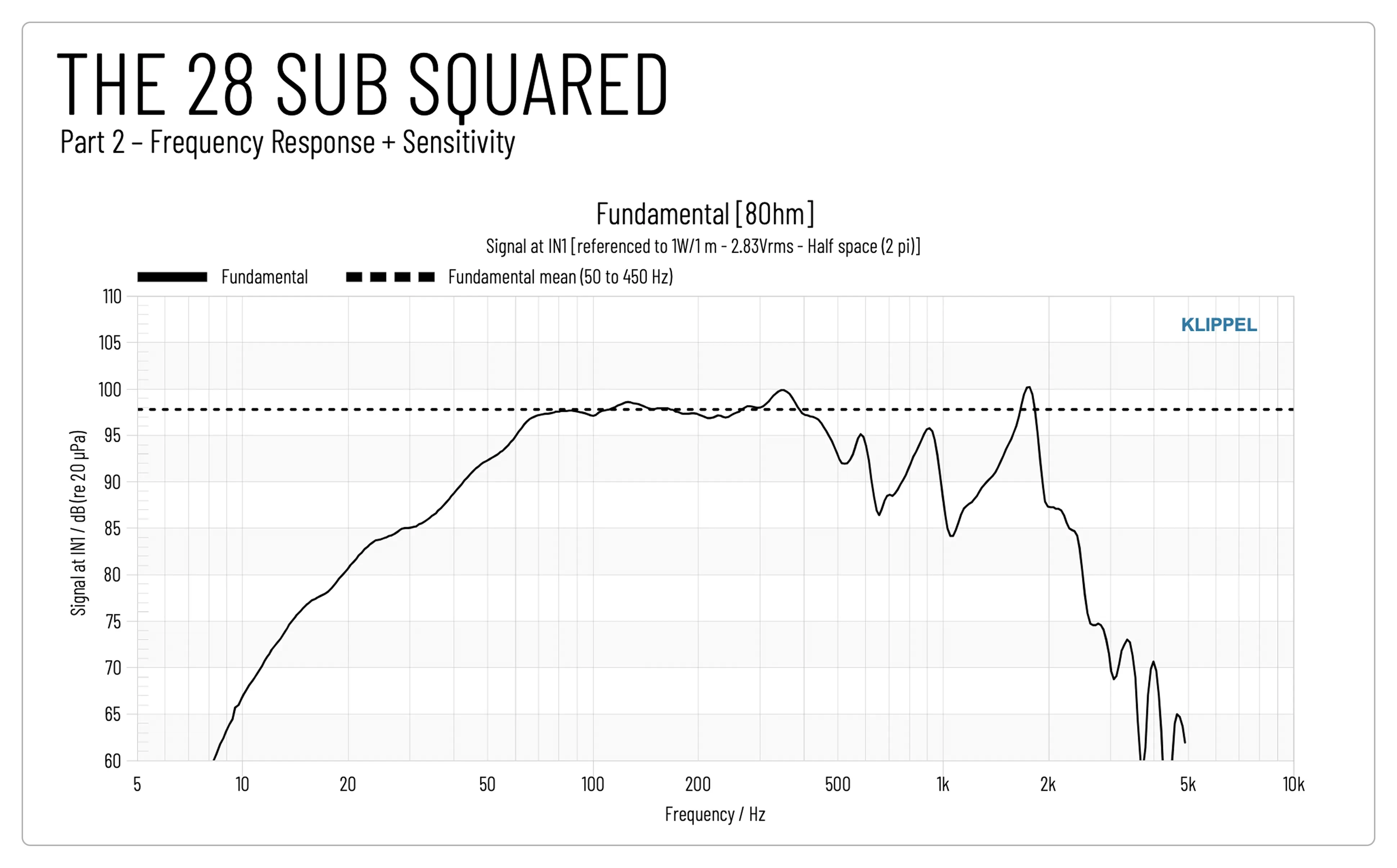
• We publish anechoic, half‑space (2π) measurements without room gain or marketing tricks.
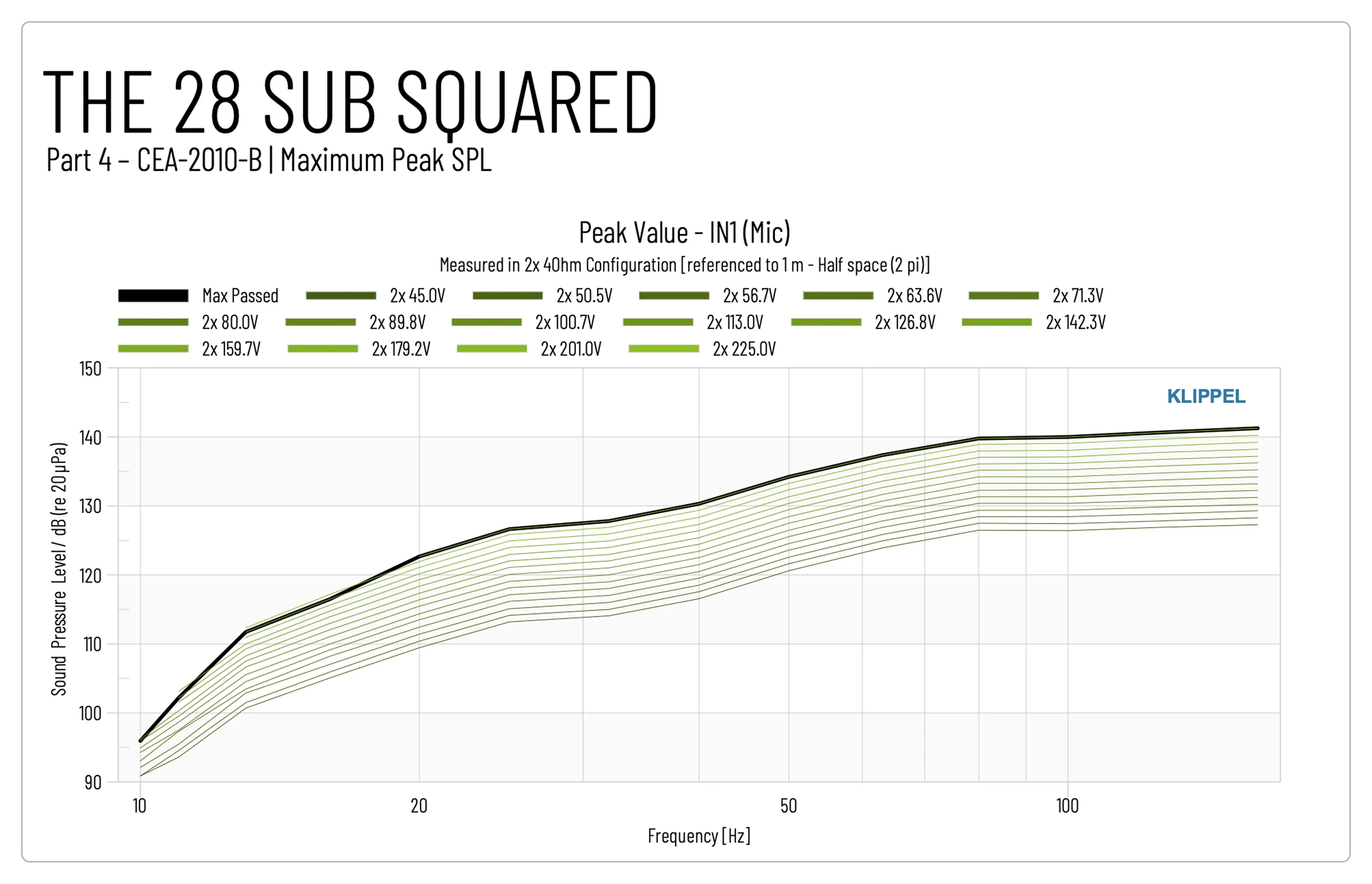
• We show raw responses at low drive and maximum clean output (CEA‑2010B) so you see what you’ll actually hear at level.
• The room helps. Room gain often adds ~6–12 dB in the bottom octave, and boundary loading is ~+6 dB per surface (wall/floor), so relative to our 2π baseline, edge placement ≈ +6 dB and corner placement up to +12dB.
• Many printed specs show deep Hz numbers that rely all on heavy EQ, limiters, or tiny‑box tunings that disappear the moment you turn your sub up.
• Physics doesn’t negotiate box size. Driver size, port area, and excursion set the limits - period.
• We design to work with those limits, not against them.
• Result: tighter, more articulate bass that maintains composure at real listening levels.
What We Measure (and Why)
- Anechoic / 2π (half‑space): No room reinforcement; our numbers are conservative by design. Your room usually adds ~6–12 dB below ~30 Hz via room gain; boundary loading adds ~+6 dB per surface, so an edge ≈ +6 dB and a corner up to +12 dB relative to our 2π baseline.
- Frequency response at low reference voltage (e.g., 2 V at 1 m): reveals the native alignment without DSP smoke and mirrors.
- CEA‑2010B measurement standard gives maximum clean output: standardized short‑burst tests show how loud the subwoofer can play at each frequency before distortion rises.
- Distortion on bursts: lets you compare not just extension, but how clean that extension is under stress.
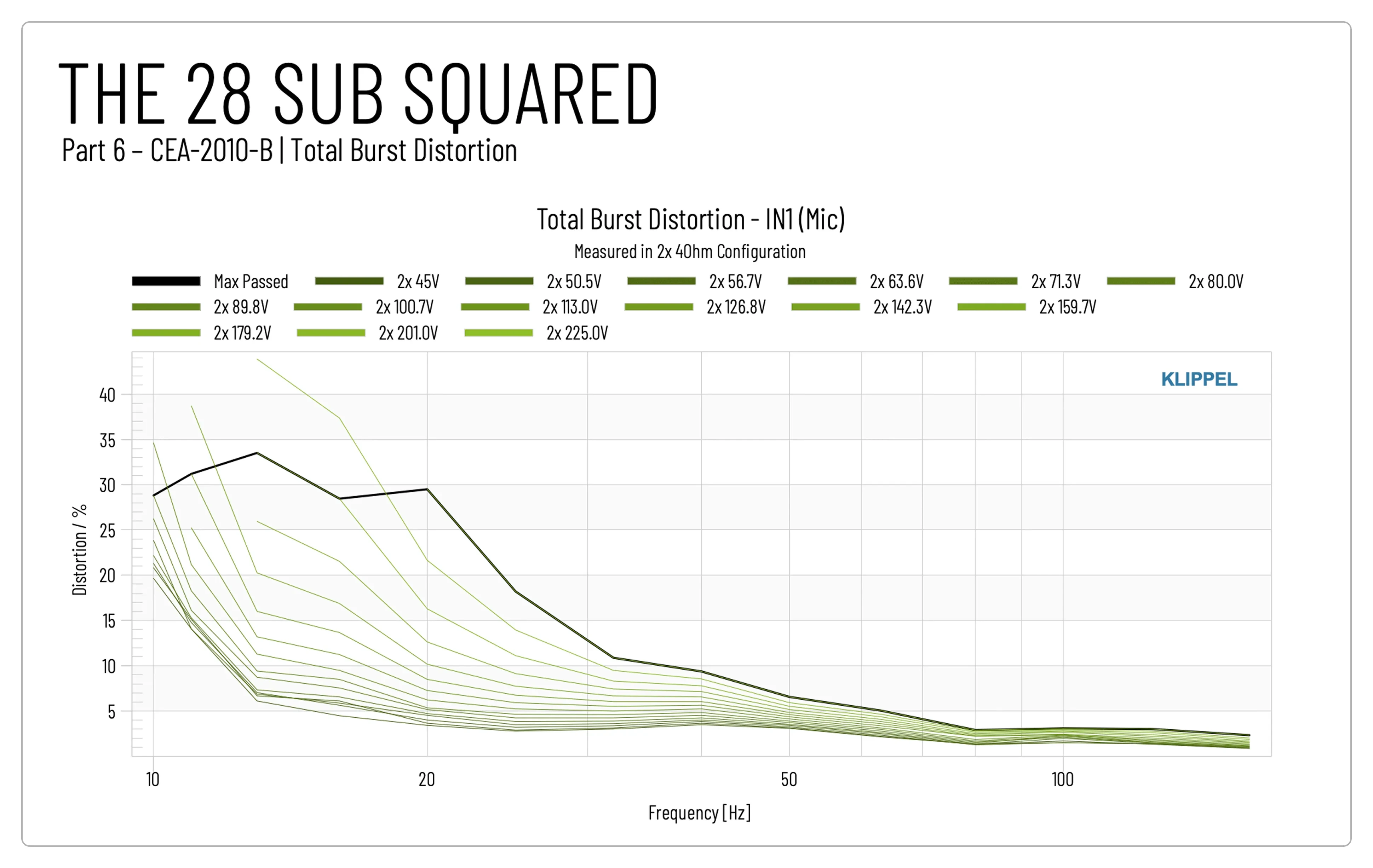
Together, these tell you:
- The honest baseline
- The real‑world ceiling
Why ‘15 Hz from a 10″/12″ Sub’ Is Misleading
Every transducer moves at 1 Hz — but without usable sound pressure (SPL), it’s inaudible.
Many claims of very deep extension come from:
- Heavy low‑shelf EQ (12–18 dB) at small‑signal levels. Looks flat on paper, but…
- Power compression and amp limiters at real volumes. The EQ boost forces the amp and woofer into their limit region early; dynamic filters then fade out the very boost that made the graph look impressive. This is why manufacturers don't show real high-power measurements.
- Tiny boxes tuned very low with undersized ports. You may see a low tuning number, but you also get chuffing, distortion, poor sensitivity, and sagging output above tuning.
The result is a spec sheet that suggests “deeper” bass yet collapses at level.
Sealed‑Box Physics in Plain Language
Keep the enclosure constant (say ~2 ft³). Swap different woofers, and you’ll find the roll‑off and F3 cluster together. You can lower F3 a bit with a heavier moving mass or extreme alignments, but you pay with 6–10 dB less sensitivity, less maximum SPL, more overhang/ “one‑note” character, and a bass that feels big but loses punch and articulation. There’s no free lunch.
How to Read Our Charts
- Anechoic/2π response: a conservative baseline that your room will improve below 30 Hz.
- CEA‑2010B Max Peak SPL: the real scoreboard. Compare output at 20, 25, 31.5, 40, 50, 63 Hz — that’s where impact lives. Higher, cleaner bars mean the deeper you can play without strain.
Our Design Philosophy
- Tell the truth in specs, then let your room add the bonus. We bet we outperform pretty much any competitor.
- Use driver size, excursion, motor strength, enclosure volume, and port area appropriate to the target bandwidth.
- Apply protective limiters, not illusory loudness tricks that vanish under volume.
- Prioritize transient accuracy and headroom, so bass stays punchy, articulate, and musical.
What to Look For (Instead of Only “Lowest Hz”)
- Max clean output (CEA‑2010B) at the frequencies you care about.
- Distortion behavior at those outputs.
- Room integration: multiple subs and placement yield smoother, deeper in‑room bass than any single spec number.
We publish conservative numbers so your expectations match what you’ll actually hear at home — tight, deep, and controlled bass that stays that way when you turn it up.
FAQ
For home theater, doesn’t the processor already linearize and low‑pass the sub?
Yes. Modern processors (e.g., Trinnov, StormAudio, Marantz/Denon) handle bass management and room EQ. They set the subwoofer crossover, align level/phase/time, and apply correction (e.g., Trinnov Optimizer, Dirac Live/Bass Control, Audyssey). Per Dolby, the LFE channel is bandwidth‑limited to 120 Hz (LPF of LFE), so the processor applies the low‑pass as part of the standard playback chain. Because of this, we publish honest anechoic baselines and design for maximum clean headroom; we avoid baking in heavy low‑frequency boosts that would stack with room EQ, waste amplifier power, and reduce dynamic range at real listening levels.
Do your subs reach the teens?
In most rooms, yes absolutely, and with authority. We just won’t print a number that requires hidden EQ or inaudible SPL to claim it.
Why don’t your graphs look ruler‑flat to 10–15 Hz?
Because they’re honest anechoic baselines. Your room will lift the bottom end; our CEA‑2010B bars show we have the headroom to use that lift.
Does bigger really matter?
For low bass, yes: bigger cone area, more excursion, more power, and the right enclosure volume all lower distortion and raise clean SPL.